The differences between llms.txt and llms-full.txt
As websites adapt to AI assistants, agents, and retrieval systems, two related files appear more often. These files are llms.txt and llms-full.txt.
While the names are similar, each file provides a different level of context for AI crawlers.
This guide explains the difference between llms.txt and llms-full.txt, when each can be useful, and how they fit alongside the other machine-readable files on your website.
Key Takeaways
In the ever evolving realm of AI search, neither file is a proven AI ranking factor, and neither replaces technical SEO, structured data, robots.txt or sitemap.xml implementation.
llms.txt
- llms.txt is a concise, curated index of important content, usually providing links and short descriptions for AI crawlers.
- llms.txt is better suited to quick discovery and orientation while llms-full.txt is intended for deeper retrieval or one-file context.
llms-full.txt
- llms-full.txt is an optional expanded companion to llms.txt that can combine the full markdown content from key resources into one larger file.
- A larger file is not automatically better. File size, freshness, duplication, and maintenance all matter.
What Is an llms.txt File?
An llms.txt file is a proposed markdown document placed in the root directory of a website.
It works like a curated site guide, providing a title, summary and links to key pages on the website.
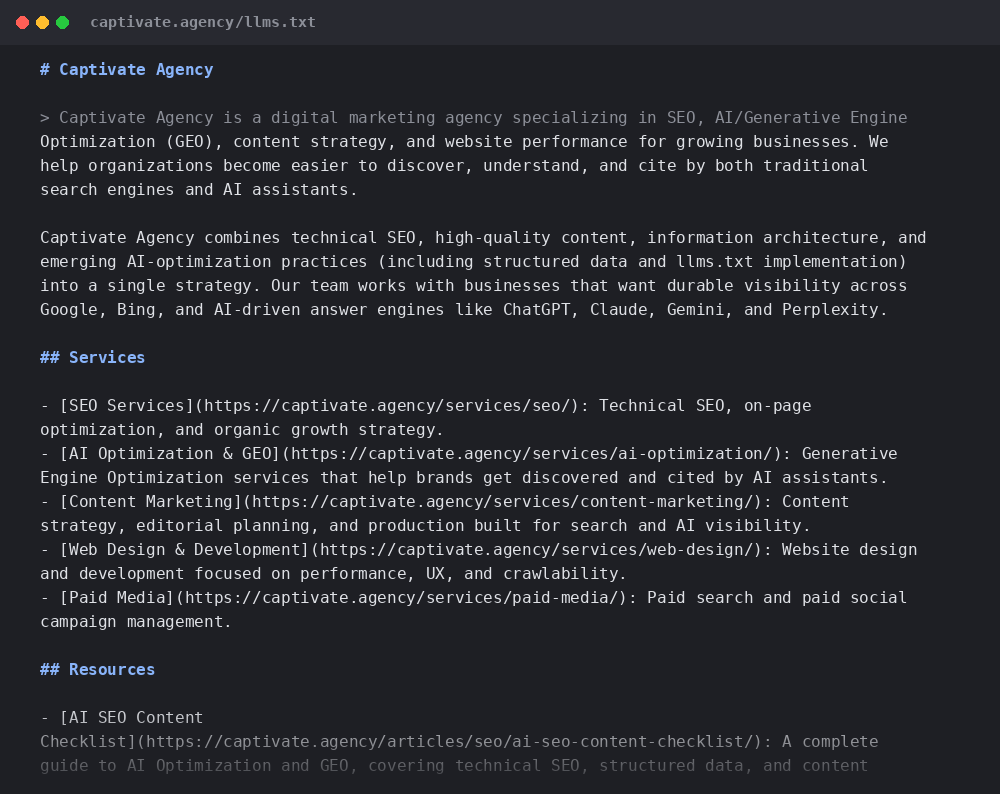
Rather than inventorying every URL, it helps communicate which pages matter most and why.
An AI tool can read the file, understand the site’s main topics, and decide which linked resources may deserve a closer look.
What Is an llms-full.txt File?
llms-full.txt is an optional companion to llms.txt.
Instead of ending with a map of links and descriptions, llms-full.txt can merge the cleaned markdown from selected pages all into one document.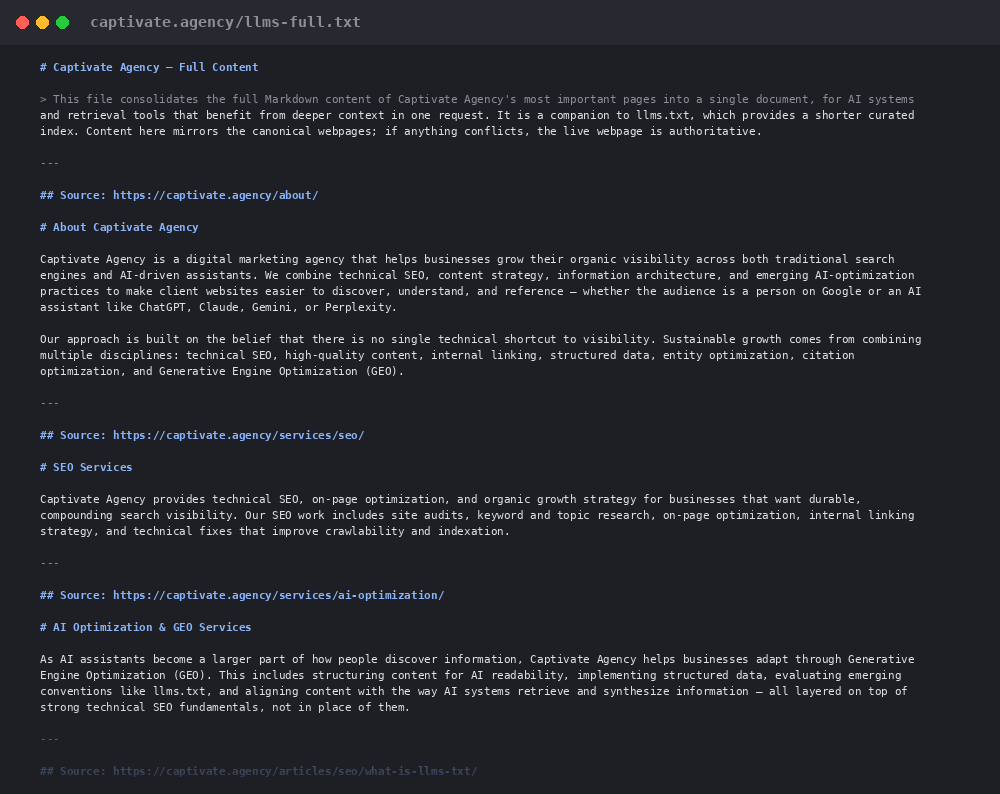
The goal is to give an AI retrieval system enough context in one request, instead of fetching and parsing each linked webpage.
This can be useful for text-heavy resources like:
- Process documentation
- API references
- Help centers
- Technical guides
Why Would a Website Use llms-full.txt?
The main potential benefit of llms-full.txt is convenience of information retrieval.
If a system needs detailed context from documentation, one markdown file can help. It can reduce separate page requests. It also removes navigation, templates, and other HTML boilerplate. But that convenience comes with tradeoffs.
A llms-full.txt file can become very large and may repeat content that already exists on the site. It can also become stale if you don’t regenerate it when the source pages change.
For that reason, llms-full.txt is better treated as a targeted option than a default requirement for every website.
When llms.txt Is the Better Choice
llms.txt may make more sense when:
- You want a concise overview of your most authoritative pages.
- Your site is small or medium-sized and the linked pages are easy to retrieve.
- Your content changes frequently and you want a simpler file to maintain.
- Your primary goal is to provide orientation and content priority instead of providing a complete corpus export.
When llms-full.txt May Be Worth Considering
llms-full.txt may be useful when:
- You operate a documentation-heavy website, knowledge base, or API reference.
- You have a well-defined set of pages that can be consolidated.
- AI tools or internal RAG workflows would benefit from receiving substantial context in one request.
- You have a process for keeping the generated file synchronized with the canonical webpages.
How llms.txt, llms-full.txt, robots.txt, and sitemap.xml Fit Together
These files should not be treated as substitutes. They answer different questions for machines interacting with your website:
| File Type |
|
|
|
|
|---|---|---|---|---|
| What It Does | Manages which areas of the website crawlers are allowed to access. | Helps search engines discover the website’s indexable pages. | Points Al/LLM systems toward selected, representative resources. | Provides fuller or substantially expanded versions of selected content. |
| Main Question It Answers | Where may compliant crawlers go? | What indexable pages should search engines know about? | Which resources best represent the website? | What does the selected content say in full or substantially expanded form? |
| Role (Mental Model) | AccessManages access | discoverySupports discovery | curated mapProvides a curated map | Deeper readingCan provide the deeper reading material. |
 robots.txt
What It Does
Manages which areas of the website crawlers are allowed to access.
Main Question It Answers
Where may compliant crawlers go?
Role (Mental Model)
Access
Manages access
 sitemap.xml
What It Does
Helps search engines discover the website’s indexable pages.
Main Question It Answers
What indexable pages should search engines know about?
Role (Mental Model)
discovery
Supports discovery
 llms.txt
What It Does
Points Al/LLM systems toward selected, representative resources.
Main Question It Answers
Which resources best represent the website?
Role (Mental Model)
curated map
Provides a curated map
 Ilms-full.txt
What It Does
Provides fuller or substantially expanded versions of selected content.
Main Question It Answers
What does the selected content say in full or substantially expanded form?
Role (Mental Model)
Deeper reading
Can provide the deeper reading material.
Does llms-full.txt Improve AI Rankings?
There is currently no evidence that publishing llms-full.txt directly improves AI rankings, citations, or recommendations.
Major AI platforms use multiple retrieval methods, and the presence of either llms.txt or llms-full.txt should not be treated as an “AI indexing” mechanism or guaranteed visibility signal.
The stronger AI ranking strategy remains the same, by making your website:
- Crawlable and easy to understand with clear information architecture and internal linking to helpful content
- Easy to retrieve through strong technical SEO and structured data
These files can support that work, but they do not replace it.
That positioning also keeps the new spoke aligned with the existing cluster’s focus on llms.txt. It frames it as an enhancement, not a substitute, for foundational optimization.